
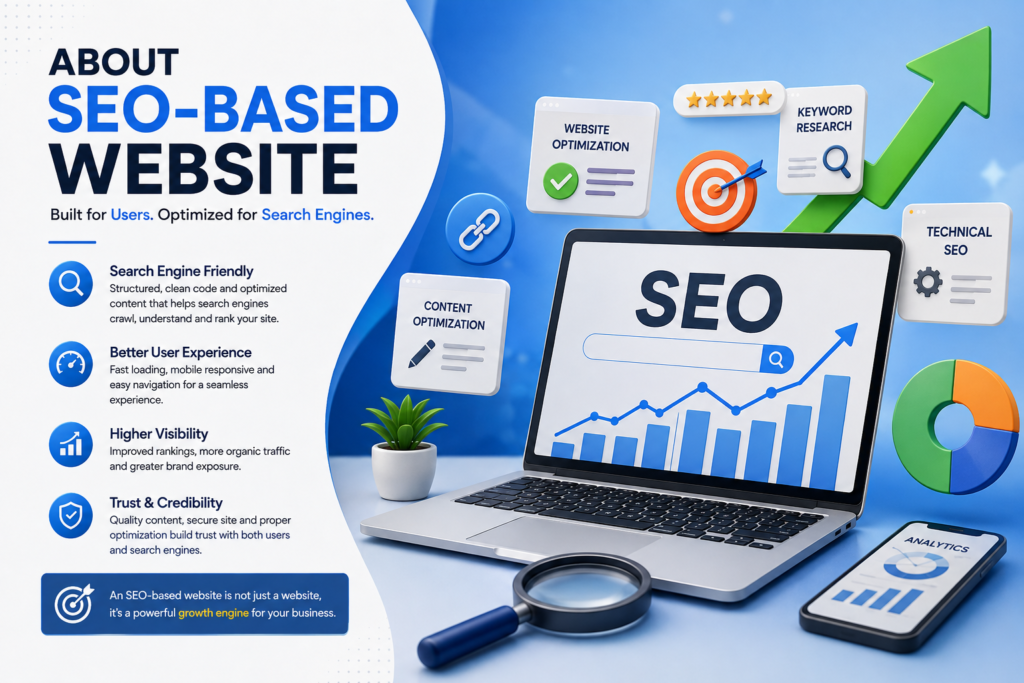
About SEO-Based Website: A Complete Guide to Building a Search-Friendly Website in 2026
In today’s digital world, having a website is no longer enough. A business may have a beautiful website, impressive products, and excellent services, but if potential customers cannot find that website through search engines, its online presence may remain limited.
This is where an SEO-based website becomes important.
An SEO-based website is designed and developed with search engine optimization in mind from the beginning. Instead of treating SEO as something that is added after a website is completed, an SEO-focused website combines technical performance, content, user experience, website structure, keywords, mobile optimization, and search intent into the overall website strategy.
For businesses, startups, agencies, bloggers, and service providers, an SEO-friendly website can become an important source of organic traffic, leads, visibility, and long-term growth.
In this guide, we will explore what an SEO-based website is, how it works, why it matters, what features it should include, and how you can build a website that is optimized for modern search engines.
What Is an SEO-Based Website?
An SEO-based website is a website created with search engine visibility as one of its core objectives.
Traditional website development often focuses primarily on design, functionality, and branding. An SEO-based website considers these elements while also making sure that search engines can efficiently crawl, understand, index, and rank its pages.
An SEO-friendly website generally includes:
Search-intent-focused content
Proper keyword targeting
Optimized page titles
Effective meta descriptions
SEO-friendly URLs
Logical website architecture
Fast loading performance
Mobile responsiveness
Optimized images
Internal linking
Structured data where appropriate
High-quality original content
Strong user experience
Technical SEO foundations
The goal is not simply to insert keywords into a website. The real objective is to create a useful digital experience that satisfies visitors while making the website easier for search engines to understand.
Why Is an SEO-Based Website Important?
Search engines are one of the primary ways people discover businesses, products, services, and information online.
Imagine someone searching for:
“Digital Marketing Agency in Chandigarh”
If your agency provides digital marketing services but your website is poorly optimized, search engines may have difficulty understanding its relevance. As a result, potential customers may discover competing websites instead.
An SEO-based website helps create a stronger connection between what users search for and what your website offers.
Major benefits include:
1. Increased Organic Visibility
A well-optimized website has a stronger foundation for appearing in relevant search results.
2. More Targeted Traffic
SEO focuses on attracting users who are already searching for information, products, or services related to your business.
3. Better User Experience
Many SEO practices also improve website usability, including faster loading, clear navigation, readable content, and mobile responsiveness.
4. Long-Term Marketing Value
Paid advertising can generate traffic while campaigns are active. SEO can continue generating organic visibility after individual pages have been published and optimized.
5. Stronger Brand Authority
Consistently publishing helpful, trustworthy, and relevant content can help a brand establish authority within its industry.
SEO-Based Website vs Normal Website
The biggest difference between a standard website and an SEO-based website is the strategy behind its structure and development.
A standard website might focus mainly on appearance and functionality.
An SEO-based website considers:
Design + Development + Content + Search Intent + Technical SEO + User Experience
For example, a normal service page might simply say:
“We provide digital marketing services.”
An SEO-focused page can provide much more useful information, such as:
What services are offered
Who the service is designed for
Problems the service solves
How the process works
Frequently asked questions
Supporting resources
Relevant internal links
Clear calls to action
This gives both visitors and search engines more context.
Keyword Research for an SEO-Based Website
Keywords remain an important part of SEO, but modern optimization is about much more than repeating exact phrases.
Keyword research should identify the language potential customers use when searching for your products, services, or information.
For example, a digital marketing company might target terms such as:
Digital marketing agency
SEO services
SEO company
Local SEO services
Google Ads management
Social media marketing
Content marketing services
However, keyword selection should also consider search intent.
A keyword with high search volume is not automatically the best keyword for a particular page.
The most useful keywords are those that match:
User Need + Search Intent + Business Offering
This combination helps create more relevant pages.
Website Structure and SEO
A strong website architecture makes it easier for users and search engines to navigate a website.
A basic SEO-friendly structure could look like:
Homepage → Services → Individual Service Pages → Supporting Blog Content
For example:
Homepage
↓
SEO Services
↓
Local SEO
↓
Google Business Profile Optimization
↓
Local SEO Guide
This creates logical relationships between pages.
A well-planned website structure can also make internal linking easier and help distribute authority throughout important pages.
SEO-Friendly URLs
URLs should be simple, descriptive, and understandable.
For example:
example.com/seo-services
is generally easier to understand than a URL containing unnecessary numbers, symbols, or complicated parameters.
SEO-friendly URLs can help users understand what a page is about before they visit it.
Good URL practices include:
Keep URLs concise
Describe the page topic
Avoid unnecessary parameters
Use readable words
Use hyphens between words
Avoid excessive keyword repetition
SEO Titles and Meta Descriptions
Every important page should have a unique and descriptive title.
The title helps search engines and users understand the primary topic of a page.
For example:
SEO Services in Chandigarh | Professional SEO Solutions
A meta description can then provide a short explanation of what the page offers.
A strong title and description should be:
Relevant
Specific
Natural
Helpful
Written for users
They should encourage the right searcher to understand why the page may be useful.
Content Is the Foundation of an SEO-Based Website
A technically perfect website cannot perform well if its content does not satisfy visitors.
Modern SEO content should focus on solving problems.
Instead of asking:
“How many times should I use my keyword?”
A better question is:
“What information does the visitor actually need?”
High-quality SEO content can include:
Detailed service information
Educational guides
Tutorials
FAQs
Case studies
Original insights
Industry explanations
Comparison content
Step-by-step resources
Content should be written naturally and organized using meaningful headings.
Search Intent Should Guide Every Page
Search intent represents the reason behind a user’s search.
A user searching:
“What is SEO?”
probably wants educational information.
Someone searching:
“SEO agency near me”
may be looking for a service provider.
Someone searching:
“SEO pricing plans”
may be comparing options before making a decision.
An SEO-based website should create pages that match these different needs instead of attempting to use one page for every search query.
Mobile-Friendly Website Design
Mobile optimization is essential for modern websites.
People access websites using smartphones, tablets, laptops, and desktop computers. A website should therefore adapt smoothly to different screen sizes.
An SEO-friendly mobile website should have:
Responsive layouts
Readable text
Properly sized buttons
Easy navigation
Optimized images
Fast loading
Minimal unnecessary elements
A visitor should not have to zoom in or horizontally scroll just to read the content.
Website Speed and Technical SEO
Website performance affects both user experience and search visibility.
A slow website can frustrate visitors and increase the likelihood that they leave before interacting with the page.
Technical SEO involves optimizing the infrastructure that allows search engines to crawl and understand a website.
Important areas include:
Crawlability
Indexability
Site speed
Mobile usability
XML sitemap
Robots.txt
Canonical URLs
HTTPS security
Redirect management
Broken links
Structured data
Website architecture
Technical SEO should be treated as an ongoing process rather than a one-time task.
Core Web Vitals and User Experience
Modern SEO increasingly connects technical performance with user experience.
Website owners should pay attention to important performance measurements and ensure pages load smoothly and respond quickly to user interactions.
A good experience means visitors can:
Find information quickly
Navigate between pages easily
Read content comfortably
Interact with buttons without delays
Access the website reliably
SEO and UX should work together rather than being treated as separate strategies.
Internal Linking Strategy
Internal links connect one page of your website to another.
For example, a blog about local SEO could naturally link to a service page about local SEO services.
Internal linking can help:
Visitors discover related information
Search engines discover pages
Establish relationships between topics
Improve website navigation
Guide users toward relevant services
The most important links should be placed naturally within useful content.
Image SEO
Images are an important part of modern websites, but they can also affect performance.
Images should be optimized by:
Compressing large files
Using appropriate formats
Providing descriptive filenames
Adding useful alternative text
Using responsive images
Avoiding unnecessarily large dimensions
For example, instead of an image named:
IMG12345.jpg
a descriptive filename might communicate the subject of the image more clearly.
Image optimization can improve accessibility, performance, and discoverability.
Local SEO for Business Websites
Businesses serving specific geographic areas should consider local SEO when building their websites.
An SEO-based local business website can include:
Location-specific service pages
Business contact information
Service areas
Customer FAQs
Local business information
Reviews where appropriate
Relevant local content
Consistent business details
For example, a salon targeting Chandigarh could create useful pages around services and locations relevant to its actual business operations.
The key is to provide genuine local value rather than creating dozens of nearly identical location pages.
AI and the Future of SEO-Based Websites
Artificial intelligence is changing the search ecosystem.
Search engines are increasingly capable of understanding context, relationships, natural language, and user intent.
This means websites should focus on becoming genuinely useful resources.
AI can assist marketers with:
Topic research
Content organization
Keyword analysis
Content ideation
Data analysis
Technical audits
However, simply producing large amounts of automatically generated content is not a substitute for expertise, originality, accuracy, and editorial quality.
The strongest SEO strategy combines technology with human judgment.
E-E-A-T and Website Trust
Trust is particularly important for websites that provide professional advice, commercial information, or important decisions.
Websites can strengthen credibility by providing:
Clear business information
Author information where relevant
Accurate content
First-hand experience
Transparent contact information
Original examples
Updated information
Appropriate references
The goal is to demonstrate that the website is created by people who understand the subject and genuinely intend to help visitors.
SEO-Based Website Content Strategy
A successful website needs a content strategy rather than random blog posts.
A simple strategy can follow this process:
Step 1: Identify Your Audience
Understand who your ideal visitors are.
Step 2: Identify Their Problems
Find the questions and challenges they commonly have.
Step 3: Research Search Topics
Identify relevant keywords and related topics.
Step 4: Create Topic Clusters
Build groups of connected pages around major subjects.
Step 5: Publish Helpful Content
Create original content that provides genuine solutions.
Step 6: Connect Related Pages
Use strategic internal linking.
Step 7: Measure Performance
Monitor organic traffic, rankings, conversions, and engagement.
Step 8: Improve Existing Pages
Update and improve content based on performance and changing user needs.
Common Mistakes When Building an SEO Website
Many websites fail to achieve their potential because of avoidable mistakes.
Some common problems include:
Designing the website without considering SEO
Targeting irrelevant keywords
Keyword stuffing
Publishing thin content
Creating duplicate pages
Ignoring mobile users
Using oversized images
Poor website navigation
Missing internal links
Ignoring technical SEO
Publishing outdated information
Creating content only for search engines
SEO should never be about manipulating search results. The strongest approach is to create a website that genuinely deserves visibility.
How to Build an SEO-Based Website in 2026
Building an SEO-friendly website requires collaboration between design, development, content, and marketing.
A practical process is:
Research → Planning → Website Architecture → Design → Development → Content → Technical SEO → Optimization → Monitoring
Before launching the website, check:
Are important pages crawlable?
Are URLs clean?
Is the website mobile-friendly?
Are titles unique?
Are pages useful?
Are images optimized?
Are internal links working?
Is the website secure?
Is the sitemap available?
Are important pages indexable?
Are calls to action clear?
After launch, continue monitoring and improving the website.
Measuring the Success of an SEO-Based Website
SEO success should not be measured by rankings alone.
Important performance indicators can include:
Organic traffic
Search impressions
Click-through rate
Keyword visibility
Qualified leads
Conversions
Engagement
Indexed pages
Backlinks and brand mentions
Revenue generated through organic search
The most valuable SEO result is not simply getting visitors.
It is attracting the right visitors and helping them take meaningful actions.
Conclusion
An SEO-based website is more than a website containing keywords. It is a complete digital platform designed around search visibility, user intent, technical performance, useful content, accessibility, and a strong user experience.
In 2026, successful SEO requires a long-term approach. Businesses need to create websites that search engines can understand and, more importantly, websites that people genuinely want to use.
From keyword research and website architecture to technical SEO, content strategy, mobile optimization, internal linking, image SEO, local search, and AI-driven search experiences, every part of the website can contribute to its organic performance.
The most effective SEO strategy is therefore simple in principle:
Understand your audience. Create genuinely useful content. Build a technically strong website. Make information easy to discover. Continuously improve the experience.
When these principles are combined, an SEO-based website can become much more than an online brochure. It can become a long-term source of visibility, credibility, leads, customers, and sustainable digital growth.