
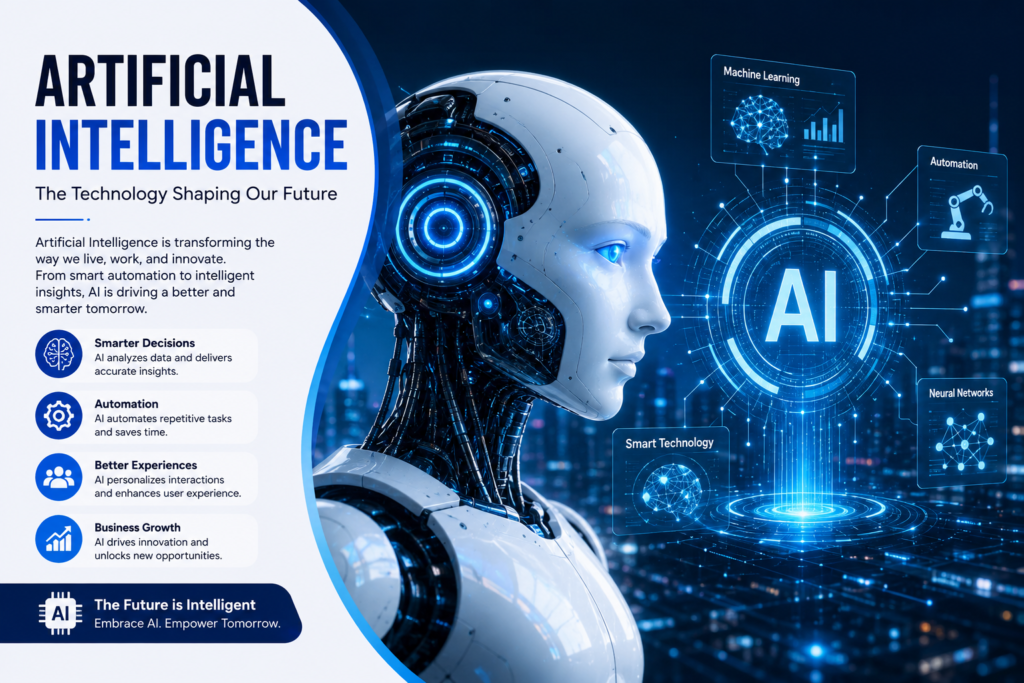
Artificial Intelligence (AI): How It Is Transforming the Future of Technology, Business, and Everyday Life
Meta Title: Artificial Intelligence (AI): Complete Guide to AI and Its Future
Meta Description: Explore Artificial Intelligence, its applications, benefits, challenges, future impact, and how AI is transforming business, education, healthcare, and everyday life.
Focus Keyword: Artificial Intelligence
Secondary Keywords: AI technology, artificial intelligence, AI applications, benefits of AI, future of AI, AI in business, machine learning, generative AI, AI automation, AI tools
Artificial Intelligence: Understanding the Technology Shaping Our Future
Artificial Intelligence, commonly known as AI, has moved from being a futuristic concept to becoming an important part of modern life. From smartphone assistants and recommendation systems to business automation and generative AI applications, intelligent computer systems are increasingly influencing the way people work, communicate, learn, shop, and solve problems.
At its simplest level, Artificial Intelligence refers to machine-based systems that can make predictions, recommendations, or decisions based on human-defined objectives. The technology combines areas such as machine learning, data processing, natural language processing, computer vision, robotics, and increasingly sophisticated generative models.
The rapid development of AI has created enormous opportunities. Businesses can automate repetitive activities, researchers can analyze complex information, students can receive personalized learning assistance, and organizations can use data to make more informed decisions. At the same time, AI introduces important questions about privacy, security, fairness, accountability, employment, and responsible technology use.
Understanding both the opportunities and limitations of AI is therefore essential for anyone preparing for the future.
What Is Artificial Intelligence?
Artificial Intelligence is a broad field of technology focused on creating computer systems capable of performing tasks that normally require aspects of human intelligence.
These tasks may include recognizing patterns, understanding language, analyzing information, making predictions, generating content, identifying objects, recommending products, or supporting decisions.
AI does not necessarily work like the human brain. Instead, different AI systems are designed for different objectives and rely on algorithms, models, data, computing resources, and predefined or learned patterns.
Machine learning is one of the most important technologies behind modern AI. It enables systems to learn patterns from data and use those patterns to produce predictions or outputs. More advanced AI systems can work with text, images, audio, video, and other forms of information.
How Does AI Work?
Although different AI technologies work in different ways, a simplified AI process can be understood through several stages.
1. Data Collection
AI systems require information to learn patterns or perform specific tasks. Depending on the application, this information could include text, images, audio, numbers, sensor readings, or other forms of digital data.
2. Data Processing
Raw information is processed and prepared so that an AI model can work with it effectively. The quality and relevance of the data can significantly influence the resulting system.
3. Model Development
Developers create or select an AI model designed for a particular task. Machine learning models can identify relationships and patterns within available information.
4. Training and Evaluation
Models are trained and evaluated to determine how effectively they perform their intended task. Testing helps identify weaknesses and potential errors.
5. Deployment
After evaluation, an AI system can be integrated into an application, website, business process, device, or other environment.
6. Monitoring and Improvement
AI systems should not simply be deployed and forgotten. Their performance, security, reliability, and outcomes need ongoing monitoring, especially when they influence important decisions.
Major Types of Artificial Intelligence
AI can be categorized in several ways, but one practical distinction is based on what systems are designed to do.
Narrow AI
Narrow AI is designed to perform specific tasks or a limited range of tasks. Most AI applications currently used in everyday life fall into this category.
Examples include recommendation systems, fraud detection tools, image recognition systems, navigation applications, and automated customer-service systems.
Generative AI
Generative AI is designed to create new content based on patterns learned from data. It can generate or assist with the creation of text, images, audio, video, software code, and other digital outputs.
Generative AI has changed how people approach writing, design, research, brainstorming, software development, and content creation.
However, generated content still needs human review. AI systems can produce incorrect information, misunderstand context, or generate outputs that appear convincing while being inaccurate.
How AI Is Changing Businesses
Artificial Intelligence is transforming businesses by improving automation, analysis, personalization, and operational efficiency.
AI in Marketing
Marketing teams use AI to analyze customer behavior, identify patterns, personalize campaigns, assist with content creation, and improve advertising decisions.
AI can help marketers understand which audiences may be interested in particular products and services. It can also support customer segmentation and recommendation systems.
The key is to use AI as a strategic assistant rather than relying on automation without human oversight.
AI in Customer Service
AI-powered customer-service systems can answer frequently asked questions, classify requests, provide basic assistance, and help businesses respond more quickly.
For complex or sensitive situations, however, human involvement remains important. Customers may need empathy, judgment, and problem-solving that automated systems cannot reliably provide.
AI in Business Analytics
Businesses generate enormous amounts of data. AI can help identify patterns within that information and support better forecasting and decision-making.
Companies can use AI-powered analytics to study sales patterns, customer behavior, operational performance, and potential business opportunities.
AI in Healthcare
Healthcare is another area where Artificial Intelligence can provide valuable assistance.
AI can support medical research, analyze certain types of medical information, assist with administrative processes, and help researchers identify patterns in large datasets.
However, healthcare applications require particularly careful oversight because errors can have serious consequences. AI should support qualified professionals rather than being treated as an unquestionable replacement for professional judgment.
The broader potential of AI includes helping address complex challenges in health and scientific research, although responsible development remains essential.
AI in Education
Artificial Intelligence is also changing education.
AI-powered learning systems can help personalize educational experiences by adapting material to different learning needs. Students can use AI-based tools for brainstorming, explanations, practice questions, language assistance, and research support.
Teachers and educational organizations can also use technology to automate certain administrative activities and create learning resources.
However, education should not become completely dependent on AI. Critical thinking, creativity, communication, independent learning, and human interaction remain essential skills.
The most effective approach is to use AI as a learning assistant while ensuring that students continue developing their own understanding and reasoning abilities.
AI in Finance
Financial organizations have been using AI and machine learning for applications such as fraud detection, risk analysis, customer support, and financial forecasting.
AI can process large quantities of information quickly and identify patterns that may be difficult to detect manually.
At the same time, financial AI systems must be carefully tested because inaccurate predictions, unfair models, privacy problems, or security weaknesses can have significant consequences.
AI and Automation
One of the biggest advantages of AI is its ability to support automation.
Traditional automation generally follows predefined rules. AI-based systems can handle more complex situations by recognizing patterns and adapting their outputs to available information.
Businesses can use AI automation for activities such as:
- Data classification
- Customer support
- Document processing
- Marketing workflows
- Business reporting
- Information extraction
- Recommendation systems
- Routine administrative activities
The goal should not simply be to automate everything. Instead, organizations should identify repetitive processes where AI can create meaningful value while keeping people involved where judgment is important.
Benefits of Artificial Intelligence
AI can provide significant advantages when implemented appropriately.
Increased Productivity
AI can assist with repetitive tasks and help people process information faster.
Better Data Analysis
AI can identify patterns in large datasets and support data-driven decisions.
Personalization
Businesses can use AI to create more relevant recommendations and experiences.
Innovation
AI can help researchers, developers, designers, and businesses explore new ideas and solutions.
Improved Accessibility
AI-powered technologies can support translation, speech recognition, assistive interfaces, and other accessibility applications.
Operational Efficiency
Organizations can use AI to optimize processes and reduce unnecessary manual work.
AI has been recognized as a technology with potential to improve productivity and help address complex challenges, while also requiring attention to its risks.
Challenges and Risks of AI
The growth of Artificial Intelligence also creates important challenges.
Privacy
AI systems may process significant amounts of information. Organizations must carefully consider how data is collected, stored, processed, and protected.
Bias
AI models can produce unfair outcomes when the data, design, or implementation introduces or reproduces bias.
Security
AI systems can become targets for attacks or can introduce new security risks if they are poorly designed or monitored.
Incorrect Information
Some AI systems can generate inaccurate information. Users should verify important outputs instead of automatically assuming that every AI response is correct.
Transparency
People may need to understand when AI is being used and, depending on the situation, why a particular output or decision was produced.
Employment Changes
AI can automate parts of certain jobs and change the skills required for others. This makes continuous learning and skill development increasingly important.
The OECD identifies privacy, safety, security, bias, discrimination, and accountability among important AI-related concerns.
Why Responsible AI Matters
The future of Artificial Intelligence should not be measured only by how powerful AI systems become. It should also be measured by how safely and responsibly they are developed and used.
The OECD AI Principles emphasize trustworthy AI that respects human rights and democratic values. They include principles relating to human agency, transparency, robustness, security, safety, and accountability.
For businesses and organizations, responsible AI means establishing clear policies around data, security, human oversight, testing, monitoring, and acceptable use.
Human judgment remains particularly important when AI systems affect people’s opportunities, privacy, safety, finances, or access to important services.
The Future of Artificial Intelligence
The future of AI is likely to involve deeper integration into everyday software, business systems, education, research, communication, and digital services.
AI systems are becoming increasingly capable of working across different types of information, including text, images, audio, and other digital inputs.
Future developments may lead to more personalized digital assistants, smarter business applications, advanced scientific research tools, improved automation, and new forms of human-computer interaction.
However, technological progress will need to be accompanied by responsible governance. As AI capabilities expand, organizations and governments will need effective approaches to privacy, safety, accountability, security, intellectual property, and information integrity. The OECD’s updated AI principles specifically address several of these areas.
The most valuable future may not be one in which humans compete directly with AI, but one in which people use AI to extend their capabilities while maintaining meaningful human control.
How Businesses Can Prepare for an AI-Driven Future
Businesses that want to adopt AI should begin with clear objectives rather than adopting technology simply because it is popular.
A practical approach includes:
Identify Repetitive Tasks
Look for processes that consume significant time and could benefit from automation.
Protect Sensitive Information
Establish clear rules about what information can be entered into AI systems.
Train Employees
Employees should understand both the capabilities and limitations of AI.
Test Before Scaling
AI applications should be evaluated carefully before being deployed across an entire organization.
Maintain Human Oversight
People should remain responsible for important decisions and review AI outputs when appropriate.
Measure Results
Organizations should evaluate whether AI is actually improving productivity, quality, customer experience, or another meaningful business objective.
AI Skills That Will Become Increasingly Valuable
As AI becomes more common, technical skills will not be the only valuable capabilities.
People will increasingly benefit from:
- Critical thinking
- Problem-solving
- Data literacy
- Digital literacy
- Communication
- Creativity
- AI-assisted research skills
- Analytical thinking
- Ethical decision-making
- Continuous learning
Learning how to work effectively with AI may become an important complement to traditional professional skills.
Frequently Asked Questions About AI
What is Artificial Intelligence?
Artificial Intelligence is technology that enables machine-based systems to make predictions, recommendations, or decisions based on human-defined objectives.
What is Generative AI?
Generative AI is a category of AI capable of creating new content such as text, images, audio, video, or other outputs.
Is AI only used by large companies?
No. AI technologies can be used by organizations of different sizes. Small businesses can use AI for areas such as customer support, marketing assistance, analytics, and workflow automation.
Can AI replace humans?
AI can automate or assist with specific tasks, but whether it can replace a particular role depends on the nature of that work. Human judgment, creativity, communication, accountability, and contextual understanding remain important in many situations.
Is AI always accurate?
No. AI systems can make mistakes and produce inaccurate or misleading outputs. Important information should be checked against reliable sources.
Why is responsible AI important?
Responsible AI helps organizations address risks involving privacy, security, fairness, transparency, safety, and accountability.
Conclusion
Artificial Intelligence is one of the most influential technologies of the modern digital era. It is changing how businesses operate, how people learn, how organizations analyze information, and how digital products are created.
Its potential is enormous, but its successful adoption requires more than powerful technology. Organizations need reliable data, skilled people, appropriate security measures, human oversight, and responsible policies.
The future of AI will ultimately depend on how effectively people balance innovation with responsibility. Businesses and individuals that learn how to use AI thoughtfully can benefit from greater productivity, new opportunities, and improved problem-solving capabilities.
AI should therefore not be viewed simply as a replacement for human effort. Its greatest value may come from combining machine capabilities with human creativity, judgment, experience, and responsibility.
As the technology continues to evolve, one thing is clear: Artificial Intelligence is not merely a technology of the future—it is already becoming a fundamental part of the digital world.