
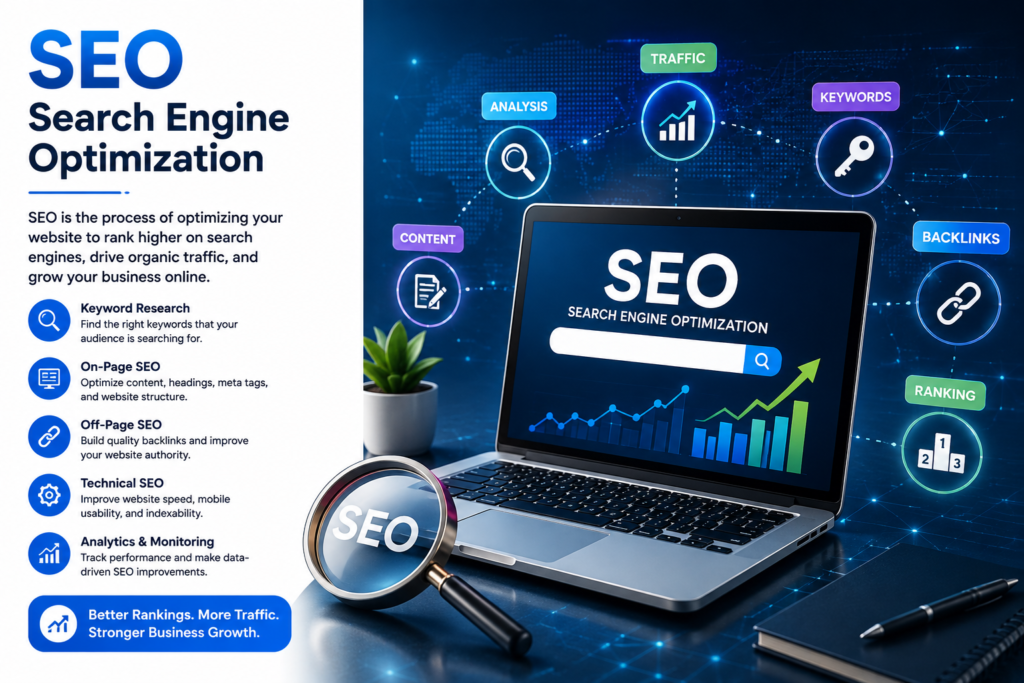
SEO: A Complete Guide to Search Engine Optimization, Strategies, Benefits, and Future Trends
Meta Title: SEO Guide: Search Engine Optimization Strategies for Better Rankings
Meta Description: Learn what SEO is, how search engine optimization works, its key strategies, benefits, and how businesses can improve visibility, traffic, and online growth.
Focus Keyword: SEO
Secondary Keywords: Search Engine Optimization, SEO strategy, SEO services, SEO techniques, Google SEO, on-page SEO, off-page SEO, technical SEO, local SEO, SEO marketing, organic traffic, keyword research
SEO Slug: seo-search-engine-optimization-guide
SEO: The Complete Guide to Search Engine Optimization
In today’s digital world, having a website is only the beginning of building an online presence. A business may have a beautifully designed website, excellent products, and valuable services, but if potential customers cannot find that website through search engines, its online potential can remain limited.
This is where SEO, or Search Engine Optimization, becomes important.
SEO is the process of improving a website and its content so that search engines can better understand, discover, and rank its pages for relevant searches. Search engine optimization combines technical improvements, content creation, keyword research, website optimization, authority building, and user experience.
For businesses, SEO can become a powerful long-term marketing strategy. Instead of depending entirely on paid advertising, companies can work toward earning organic visibility in search results.
However, successful SEO is not about adding keywords to a webpage repeatedly. Modern search optimization is much broader. Search engines aim to provide users with useful and relevant results, which means websites need to focus on quality, usefulness, accessibility, credibility, and a positive user experience.
This comprehensive guide explains what SEO is, how it works, its major types, important strategies, benefits, common mistakes, and the future of search engine optimization.
What Is SEO?
SEO stands for Search Engine Optimization.
It refers to the process of improving websites and digital content to increase their visibility in unpaid or organic search engine results.
When someone searches for a product, service, question, location, or topic, search engines analyze many signals to determine which results may be most useful.
For example, someone searching for:
“best digital marketing agency in Chandigarh”
may see websites, local business listings, articles, maps results, videos, and other search features.
An effective SEO strategy helps a business increase its chances of appearing when potential customers search for relevant topics.
SEO generally involves several areas:
Keyword research
Content optimization
On-page SEO
Technical SEO
Off-page SEO
Local SEO
Website performance
User experience
Internal linking
Search intent
Authority and credibility
Why Is SEO Important?
Search engines are one of the primary ways people discover information, businesses, products, and services online.
Imagine having a store in a busy city but placing it on a street where almost nobody visits. Even if the products are excellent, attracting customers would be difficult.
A website can face a similar problem.
SEO helps businesses improve their online discoverability so that relevant users have a better opportunity to find them.
Some major advantages of SEO include:
Increased Organic Visibility
SEO can help websites appear for relevant search queries without paying for every individual click.
Long-Term Traffic Potential
Well-optimized pages can continue attracting visitors over an extended period when they remain useful and competitive.
Better Brand Awareness
Repeated visibility in search results can help people become familiar with a brand.
Improved User Experience
Many SEO improvements, such as faster websites, clear navigation, readable content, and mobile optimization, also improve the user experience.
Qualified Traffic
When a page ranks for a search that matches its offering, the visitors arriving at the website may already have an interest in the topic, product, or service.
How Do Search Engines Work?
Search engines generally perform several major activities to organize information across the web.
Crawling
Search engine systems discover webpages by following links and using other discovery mechanisms.
Indexing
After discovering content, search engines analyze and store information about webpages so they can potentially be shown in search results.
Ranking
When a person performs a search, the search engine evaluates relevant information and determines which results are most useful for that particular query.
This is why SEO requires more than simply publishing a webpage.
A page needs to be accessible, understandable, relevant, useful, and competitive for the search queries it is targeting.
The Three Main Types of SEO
SEO is commonly divided into three major areas: On-Page SEO, Off-Page SEO, and Technical SEO.
1. On-Page SEO
On-page SEO refers to improvements made directly to the webpage and its content.
Important elements include:
Page titles
Headings
Content structure
Keywords
Meta descriptions
Internal links
Image optimization
URLs
Content quality
Search intent
Keyword Placement
Keywords help search engines understand what a page is about.
However, keywords should be used naturally.
For example, if a webpage targets the keyword “SEO services in Chandigarh,” the phrase could naturally appear in the page title, introduction, relevant headings, body content, and metadata where appropriate.
Repeating the same keyword excessively can make content difficult to read and may create a poor user experience.
2. Off-Page SEO
Off-page SEO refers to activities that take place outside the website and can contribute to its reputation and authority.
One of the best-known elements is link building.
A backlink occurs when another website links to your website.
Not every backlink has equal value. Links from relevant, trustworthy, and authoritative websites can be more meaningful than large numbers of unrelated or low-quality links.
Other off-page activities can include:
Digital PR
Brand mentions
Industry partnerships
Relevant citations
Content promotion
Relationship building
Genuine community engagement
The objective should be to build a trustworthy online presence rather than simply collecting links.
3. Technical SEO
Technical SEO focuses on the technical foundation of a website.
Important areas include:
Website speed
Mobile usability
Crawlability
Indexability
Site architecture
HTTPS security
Structured data
XML sitemaps
Canonical URLs
Redirect management
Broken links
A technically strong website makes it easier for search engines to discover and understand its content.
It can also provide visitors with a smoother browsing experience.
Keyword Research: The Foundation of SEO
Keyword research involves identifying the words and phrases people use when searching for information, products, or services.
For example, a digital marketing agency may research keywords such as:
Digital marketing agency
SEO services
SEO company
Social media marketing agency
Google Ads services
Content marketing services
Local SEO services
However, keyword research should go beyond search volume.
Businesses should also consider:
Search Intent
What does the user actually want?
Someone searching “what is SEO” probably wants educational information.
Someone searching “SEO agency near me” may be looking for a service provider.
Someone searching “SEO pricing” may be comparing costs.
Understanding intent helps businesses create the right type of content.
Content Is a Core Part of SEO
Search optimization and content marketing work closely together.
A website needs useful content to rank for relevant searches.
Strong SEO content should:
Answer user questions
Provide useful information
Be easy to read
Use appropriate headings
Include relevant keywords naturally
Demonstrate knowledge of the subject
Avoid unnecessary repetition
Provide a clear purpose
Businesses can create different forms of content, including:
Blog posts
Service pages
Product descriptions
Guides
Case studies
FAQs
Tutorials
Comparison articles
Industry reports
The goal should be to create content for people first while making it understandable to search engines.
Local SEO
Local SEO is especially important for businesses that serve customers in specific geographic areas.
Examples include:
Restaurants
Salons
Dental clinics
Retail stores
Real estate businesses
Digital marketing agencies
Repair services
Hotels
A local SEO strategy may include optimizing a Google Business Profile, maintaining accurate business information, collecting genuine customer reviews, creating location-relevant content, and ensuring consistency across online business listings.
For example, a business targeting Chandigarh may create useful pages around relevant local searches such as:
“SEO services in Chandigarh”
or
“Digital marketing agency in Chandigarh.”
Local SEO helps businesses compete for customers who are actively searching for nearby products and services.
Technical Website Performance and SEO
Website performance can significantly influence the overall user experience.
A slow website may frustrate visitors and increase the likelihood that they leave before interacting with the content.
Businesses should pay attention to:
Page loading performance
Image file sizes
Mobile responsiveness
Browser compatibility
Server performance
Core Web Vitals
Unnecessary scripts
Optimizing these areas can make websites easier and more enjoyable to use.
Mobile SEO
People increasingly access websites through mobile devices.
A website that looks excellent on a desktop but performs poorly on a smartphone can lose valuable visitors.
Mobile-friendly websites should provide:
Responsive layouts
Readable text
Easy navigation
Touch-friendly buttons
Fast loading
Properly sized images
Simple forms
Mobile optimization should be treated as a fundamental part of website development rather than an optional feature.
Internal Linking
Internal links connect one page of a website to another page on the same website.
For example, a blog about SEO could link to related pages about:
Keyword research
Technical SEO
Local SEO
Content marketing
SEO services
Internal linking can help users discover related information and can help search engines understand the relationship between pages.
A strong internal linking structure can also help distribute authority throughout a website.
SEO and User Experience
Modern SEO is closely connected with user experience.
A webpage should not be designed only to satisfy search engine algorithms.
It should help real people accomplish their goals.
A good user experience includes:
Clear navigation
Useful information
Attractive design
Easy-to-read content
Fast performance
Mobile compatibility
Clear calls to action
Accessible page structure
When SEO and user experience work together, websites can become more useful for both visitors and search engines.
Common SEO Mistakes to Avoid
Many businesses make SEO more complicated than necessary.
Here are some common mistakes.
Keyword Stuffing
Using the same keyword excessively can make content unnatural.
Duplicate Content
Publishing substantially duplicated content across multiple pages can create confusion and reduce the usefulness of a website.
Buying Low-Quality Backlinks
Large quantities of irrelevant or manipulative backlinks can create unnecessary risk.
Ignoring Technical SEO
Excellent content cannot reach its full potential if search engines cannot properly access or understand the website.
Writing Only for Search Engines
Content should primarily serve the audience.
Ignoring Search Intent
Ranking for a keyword is not enough if the page does not answer what the searcher actually wants.
Neglecting Mobile Users
A poor mobile experience can negatively affect engagement and usability.
How to Create an Effective SEO Strategy
A successful SEO strategy should begin with research and clear objectives.
Step 1: Understand Your Audience
Identify who your customers are and what information they need.
Step 2: Research Keywords
Find relevant search terms and group them according to intent.
Step 3: Analyze Competitors
Study competing websites to identify content opportunities and weaknesses.
Step 4: Improve Website Structure
Make navigation, URLs, internal links, and page organization logical.
Step 5: Create Valuable Content
Publish original, useful resources that answer important customer questions.
Step 6: Optimize Existing Pages
Improve titles, headings, metadata, content, images, internal links, and other on-page elements.
Step 7: Strengthen Authority
Promote useful content and build relationships that can generate legitimate mentions and links.
Step 8: Measure Performance
Track organic traffic, rankings, conversions, engagement, and other meaningful metrics.
Step 9: Continue Improving
SEO is not a one-time activity. Search behavior, competition, technology, and search engine systems continue to evolve.
Measuring SEO Performance
SEO should be evaluated using meaningful business and website metrics.
Important measurements can include:
Organic traffic
Search impressions
Click-through rate
Keyword visibility
Conversion rate
Leads
Revenue
Engagement
Indexed pages
Backlink quality
Rankings are useful, but they should not be the only measurement.
A keyword ranking at the top of search results has limited business value if it produces no relevant visitors or conversions.
The ultimate objective should be meaningful growth.
SEO and Artificial Intelligence
Artificial intelligence is changing how people search for information and how marketers create and optimize content.
AI tools can assist with:
Keyword research
Content planning
Data analysis
Content outlines
Search intent analysis
Technical audits
Reporting
Marketing automation
However, AI-generated content should not automatically be considered high-quality content.
Human review remains important for accuracy, originality, expertise, context, and usefulness.
The strongest approach is to use AI as a productivity tool while maintaining human responsibility for the final result.
The Future of SEO
The future of SEO is likely to become increasingly focused on user needs, content quality, context, and broader search experiences.
Search is no longer limited to ten traditional blue links. Users may discover information through maps, videos, images, featured results, shopping experiences, AI-powered interfaces, and other search features.
This means businesses should build a broader digital presence rather than depending on a single ranking position.
Future-ready SEO will likely require a combination of:
High-quality content
Strong technical foundations
Brand authority
User experience
Multimedia content
Local visibility
Structured information
Authentic expertise
Continuous measurement
The fundamental principle remains simple: create something genuinely useful for the person searching.
Frequently Asked Questions About SEO
What does SEO stand for?
SEO stands for Search Engine Optimization.
What is the main purpose of SEO?
The primary purpose of SEO is to improve a website’s visibility in relevant organic search results and attract valuable visitors.
How long does SEO take to show results?
SEO results can vary depending on competition, website authority, content quality, technical condition, industry, and strategy. SEO generally requires consistent effort rather than expecting immediate results.
Is SEO better than paid advertising?
SEO and paid advertising serve different purposes. SEO can provide long-term organic visibility, while paid advertising can generate traffic more quickly when campaigns are properly managed. Many businesses benefit from using both.
Is SEO still important?
Yes. Search remains an important way for people to discover information, products, services, and businesses. However, successful SEO continues to evolve alongside changes in search technology and user behavior.
Can a small business benefit from SEO?
Yes. Local SEO, specialized content, strong service pages, and focused keyword strategies can help smaller businesses compete for relevant searches.
Conclusion
SEO is much more than inserting keywords into website pages. It is a comprehensive digital marketing discipline that combines content, technology, user experience, research, authority, and continuous improvement.
A successful SEO strategy begins by understanding what users are searching for and why they are searching for it. From there, businesses can create useful content, build technically strong websites, improve local visibility, establish authority, and measure meaningful results.
The most effective SEO strategy is not based on shortcuts. It is built around consistency, relevance, usefulness, and trust.
Businesses that invest in SEO today can create a stronger foundation for long-term online visibility. By combining technical optimization with valuable content and a customer-first approach, a website can become more discoverable while providing a better experience for the people who visit it.
As search continues to evolve, the businesses most prepared for the future will be those that focus less on manipulating rankings and more on earning visibility by genuinely helping their audience.
SEO is therefore not simply a method for gaining website traffic. It is a long-term strategy for building discoverability, credibility, customer relationships, and sustainable digital growth.
SEO Publishing Checklist
Primary Keyword: SEO
SEO Title: SEO: The Complete Guide to Search Engine Optimization
Meta Description: Learn what SEO is, how search engine optimization works, its key strategies, benefits, and how businesses can improve visibility, traffic, and online growth.
URL Slug: seo-search-engine-optimization-guide
Suggested Image Alt Text: SEO search engine optimization strategy for improving website rankings
Suggested Image File Name: seo-search-engine-optimization-guide.jpg
Suggested Categories: SEO, Digital Marketing, Search Engine Optimization
Suggested Tags: SEO, Search Engine Optimization, SEO Strategy, Google SEO, On-Page SEO, Off-Page SEO, Technical SEO, Local SEO, SEO Services, Organic Traffic
Originality Note: This article is written from scratch in original wording. No writer or AI system can honestly guarantee that no phrase has ever appeared anywhere on the internet, or guarantee future uniqueness against every existing and future webpage. The article is designed to be original, useful, naturally keyword-focused, and suitable for SEO publication rather than copied from another source.